






 Support our Stories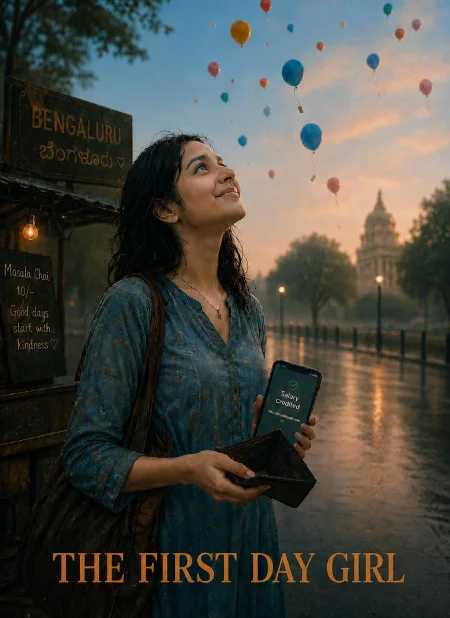

 7 min read
 Part 1
Aanya Verma was twenty-eight, living in a small, rented flat in the heart of Bengaluru. Every first day of the month, her phone would buzz with a notification: “Salary credited: ₹74,812,” and for a moment, her heart would leap like a sparrow startled into flight. And then, almost as quickly, reality would land with its heavy feet: a rent reminder from her landlord, an EMI message from her bank, and bills for electricity, groceries, and her mother’s medications.
Within minutes, her fresh salary became a spreadsheet, neat, predictable, lifeless.
***
One day, sitting on her balcony with her tea, she said aloud to herself, “I want to spend my entire salary in one day. Just once.”
Her flatmate, Nidhi, laughed. “Aanya, that’s the dumbest dream ever. You’d go broke.”
Aanya smiled. “Maybe. But for that one day, I want to feel like money doesn’t own me.”
The first time she tried it, she failed spectacularly.
She began the day with a rush of adrenaline; she’d planned to spend every rupee before midnight. She took a cab instead of her usual bus, tipped the driver extra, and treated herself to an expensive breakfast at Lavonne. But halfway through her almond croissant, she began calculating how much was left in her account.
By afternoon, she had already backed out of buying the silk sari she had admired for months.
By evening, she was back home, guilty and defeated.
“I can’t do it,” she admitted to Nidhi.
“Of course you can’t,” Nidhi said, smiling. “We’re not built to be free. We’re built to survive.”
But the thought didn’t leave Aanya.
Over the following months, Aanya began to ask herself why she wanted to do it.
What was this strange urge to spend it all? It wasn’t greed. She didn’t want diamonds or designer shoes. It wasn’t rebellion either. It was something quieter, the wish to reclaim herself from the cycle of earning and waiting, of wanting and postponing. She didn’t want more things. She wanted more moments. Every time she bought something sensible – groceries, detergents, train tickets – she felt as if she was feeding a machine that would never stop asking for more. She wanted to say no to that machine. Just once.
***
One evening after work, she stopped at a roadside café for a cup of drip coffee. It was raining, and the city’s noise had mellowed into a soft drizzle of conversations and car horns. At the next table sat an old man in a crumpled linen shirt, sketching on a notepad. He caught her eye and smiled.
“You look like someone trying to solve an impossible math problem,” he said.
Aanya laughed. “I’m trying to figure out how to spend all my money in a single day.”
The man chuckled. “Ah, the First Day Syndrome. I used to have it too.”
“You did?”
“Yes. I used to be a banker. Numbers ruled my life. Then one day, I realized I was saving for a future that never really existed. So, I quit.”
“What did you do then?”
“I started spending differently. Not all at once, but with purpose. I bought moments. I paid for time.”
“Time?”
He nodded. “Pay someone’s bus fare. Fund a stranger’s meal. Buy a story, not a thing.”
His words lingered long after the coffee cooled.
That night, Aanya made a new plan. She wouldn’t waste her salary in a day. She would release it, set it free like birds leaving a cage. She made a list of things she could do:
– Buy every single balloon from the old vendor outside Cubbon Park and give them to the kids playing there.
– Pay for everyone’s tea at the corner stall near her office.
– Clear someone’s pending hospital bill.
– Tip the housekeeping staff an entire month’s wage.
– Buy a train ticket to nowhere and come back with the sunrise.
She fell asleep with a strange peace in her chest.