



 Support our Stories
 5 min read
Many writers begin their writing journey as passionate genre readers – Action, Adventure, Crime, Fantasy, Fiction, Horror, Mystery, Romance, Sci-Fi, Thriller… you name it. After years of devouring the great authors in their favourite genres, their first original story ideas eventually start to appear. And those ideas can feel big, maybe this is the next great saga – the next Dune, A Song of Ice and Fire, or The Dark Tower series.
It’s possible. It’s achievable. But it’s also one of the hardest ways to learn the craft of writing.
The problem is that loving a genre and enjoying great books do not automatically translate into knowing how to write one. Writing is a craft, and craft requires practice. A new writer needs to work on many aspects of writing: voice, clarity, imagery, dialogue, themes, characters, plot, structure, pacing, and more. That takes time and commitment. Starting with a large-scale project can quickly become overwhelming and discouraging. This is where short stories become incredibly useful. They give you a manageable space to practice the craft, make mistakes, learn from them, and try again.
If you want to become a better writer, short stories are one of the smartest places to practice. It’s a literary microcosm that forces you to make every word count, sharpening your language, openings, scenes, and endings. You learn how to ‘show’ instead of ‘tell’ because there is little room to waste. At the same time, short fiction strengthens your story instincts: how to build conflict, raise stakes, control pacing, and deliver a satisfying resolution. Best of all, short stories give you room to experiment. You can try new voices, genres, points of view, and styles without committing months or years to a single project.
The benefits of writing short stories really cannot be overstated. Short fiction is one of the most practical training grounds for new writers because it lets you experience the entire writing process within a manageable project.
1. Short Stories Are a Fast Way to Become a Better Writer
You will certainly improve writing with short stories. When writing short fiction, you get to practice nearly every aspects of writing within a limited space that is easier to control.
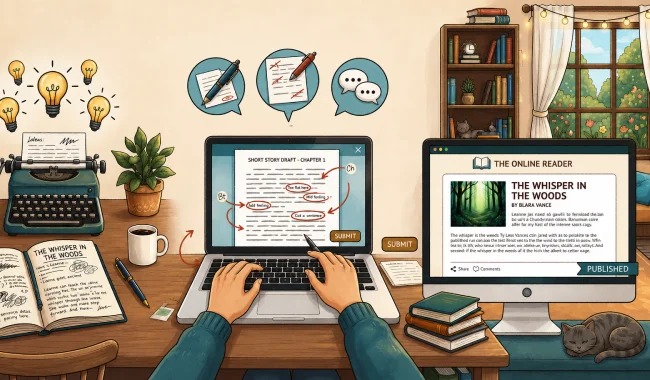
You get to experience the joy of laying down the creative idea in your first draft, then the work of improving the story and your prose: developing your voice, experimenting with dialogue, strengthening your characters, and learning how to prepare a clean manuscript for the publishers – The Chicago Manual of Style.
2. Repetition Is the Mother of Writing Practice
One of the greatest benefits of writing short stories is repetition. With each story, you practice the full process – from idea and first draft to revision, editing, proofreading, and formatting. Then you do it again.
That repetition builds confidence and skill. You learn to recognize what works, what doesn’t, and where a story needs improvement. Over time, your writing becomes more natural, your voice emerges, and your collection of stories grows.
3. Short Fiction Eliminates the Overwhelming Scope
Which sounds more achievable for someone who has just decided to start writing fiction?
Write Book One of a seven-book fantasy saga, with 100,000+ words in the first book alone, and spend months finishing the first draft, followed by multiple rounds of revision and editing. Or write a short story of around 3,000 words, draft it in a day, over a weekend, or across a few evenings, then start editing the following week and, depending on your experience and available time, have a clean draft within a week or two.
The second option is clearly more manageable. That’s the advantage of short fiction: it eliminates the overwhelming scope of a large project, allowing you to practice your craft without losing momentum.
There is also something motivating about finishing a story. You have an idea. You write it. You revise it. You finish it. You can then share it with your writing peers or submit it to Talking Leaves Fiction.
Try making it your homework: write one fully edited, clean story every month. That’s an accomplishment. Do it twelve times, you’ll have twelve finished stories and a year of writing practice behind you. Those small accomplishments can build a sustainable writing habit and the beginnings of a short story collection.
4. Short Fiction Gives You Permission to Experiment
Another advantage of short fiction is that the stakes are low. Not every story will work – and that’s okay.
Some ideas will fall flat. Some characters won’t come alive. Some endings won’t land. It’s much easier to learn from a 3,000-word story than a 100,000-word novel you’ve spent years writing. Short fiction gives you room to fail, experiment, and move on. The goal isn’t to write a perfect story. It’s to become a better writer with every story you finish.
At Talking Leaves Fiction, we’re always looking for new voices and original fiction. Visit our Become Our Writer page to learn how to submit your work.