






 Support our Stories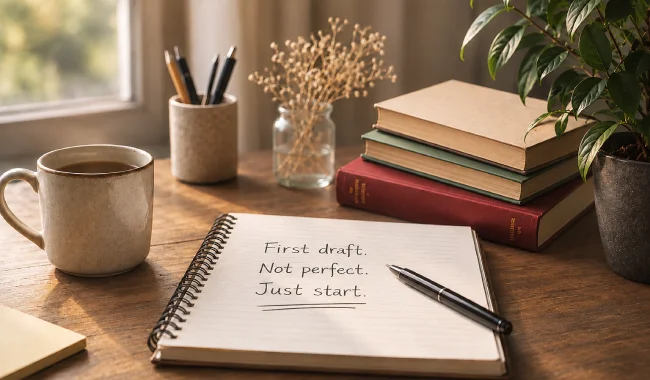
 4 min read
Starting a creative writing journey can feel overwhelming. New writers often get stuck before they even begin: searching for the perfect opening sentence, agonizing over a single word, or adjusting margins and fonts to make a draft look like a published book before they’ve finished a paragraph. It’s Garamond, but it’s meant for reading, not writing – and yes, there is a difference. The problem isn’t perfectionism itself. The problem is trying to perfect something that doesn’t exist yet. So how do you stop overthinking and actually start writing short stories?
You lower the stakes. You don’t need a masterpiece on day one. You need a first draft. And you need habits that make writing possible in the first place – before you can write better stories. Let’s strip away the mystique of the “inspired genius” and replace it with practical mechanics. Writing is a practice. You can train your brain to notice stories, your eye to understand how they work, and your hands to keep moving when your inner critic tells you to stop.
Whether you want to write sci-fi, fantasy, literary fiction, or romance, this simple 30-day routine can help build your writing muscles.
1. Read Like a Writer
You cannot write compelling short fiction if you don’t actively read it. Reading is your primary form of fiction research. It’s how you absorb pacing, character development, world-building, dialogue, and narrative tension.
Read widely. Read outside your preferred genre. Read novels, short stories, essays, cereal boxes, and restaurant menus – yes, why not? Stories are everywhere. But if you want to write in a particular genre, spend serious time reading that genre. Want to write science fiction? Read science fiction. Planning to write horror? Read contemporary horror. Interested in literary fiction? Pay attention to what literary journals are publishing.
You’re not simply looking for stories you enjoy. You’re learning what makes a story work.
The Three-Stories-a-Week Challenge
For the next 30 days, read three short stories every week. After each one, write a 150-word story breakdown:
- Plot Summary: In two or three sentences, describe the central narrative arc. What happens, and what changes?
- Craft Thoughts: What worked? What didn’t? Did the opening pull you in? Did the ending land? How did the author handle dialogue, description, character, or tension?
The 150-word limit forces you to pinpoint what matters. Instead of simply saying, “I liked it,” you have to ask yourself why.
Three stories a week for four weeks gives you twelve stories studied closely – and a much sharper editorial eye.
2. Write Before Your Inner Critic Wakes Up
Reading teaches you how stories work. Now you need to get your hands moving.
Many writers get trapped here: you write a sentence, hate a word, hit backspace, rewrite it, and twenty minutes later you have one sentence. Your internal editor is arriving far too early.
The Five-Minute Typing Sprint
Set a timer for exactly five minutes. Put your fingers on the keyboard or your pen on the page. When the timer starts, write as quickly as you can.
The rules:
- Ignore grammar. Punctuation is optional. Sentence – what sentence? Grammar can wait.
- Ignore typos. Misspell something? Leave it. Do not hit backspace.
- Keep moving. If you run out of ideas, write “I don’t know what to write” until another thought appears. Then follow it.
- Don’t judge the result. This is an exercise in momentum, not literary talent.
The goal is absolute, unfiltered forward motion. You’re training your brain to stop second-guessing every syllable and building a direct connection between thought and page.
3. Put the Two Habits Together
Now combine the exercises. Read three stories. Analyze each in 150 words. Then write for five minutes. That’s it.
Over time, you’ll start noticing why certain openings work, and why an ending lands. Then you can experiment with those techniques in your own work. That’s how craft moves from something you understand to something you can use.
4. Give Yourself 30 Days
By week four, the blank page should feel less threatening. You’ll have studied twelve stories and completed thirty days of writing sprints. Writing doesn’t always require inspiration. The secret is to lower the stakes. Stop trying to write a perfect story on your first attempt. Read, analyze, write, repeat – and let the habit do the heavy lifting.
Once you’ve turned your favourite ideas into polished stories, it’s time to share them. At Talking Leaves Fiction, we’re always looking for new voices and original fiction. Visit our Become Our Writer page to learn how to submit your work.
Your first story doesn’t have to be perfect. It just has to begin.