


 Support our Stories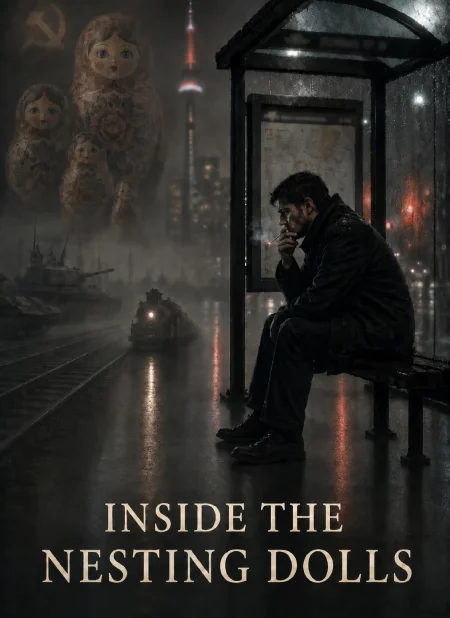

 10 min read
 Part 2
He sat down. A Black man sat across from him. The man’s eyes were closed, and his body swayed with the moving bus. Stefan pulled out a book. A bowler hat levitated on the white cover. He cracked it open.
Stefan stared into the book. Reading is the chronic condition of introverts. He’d tried to read the Czech original before, but the picture of the author on the cover – jeans, white suit, cigar, and a slim grin – irritated him. The ego-tobacco whang in the writer’s mouth infuriated him. Being Slovak in Czechoslovakia meant listening to the Czech tongue in the media. After a childhood of Czech, the Czech felt appropriate, more fitting for poetry, music, movies, and art than Slovak. He never mastered Slovak grammar. Czech colonial nesting doll inside a Russian colonial nesting doll. After years in Canada, the sounds of both Czech and Slovak dissipated into a repulsion for their awkward accents.
“That’s a nice book cover.” The Black man smiled. His arm spread over the back of the bench. Stefan’s glands gushed adrenaline into his bloodstream. His eyes stared at the man’s polished black shoes and slowly moved up from his pants to his coat and face. He’d waited a year and three months for this moment, the moment to engage a stranger with books. Just for a second, just a brief exchange, a small sentence, a shard of the other person’s mind. His hands shook. Stefan looked at the cover.
“Yes,” he answered, stupefied.
“The Unbearable Lightness of Being. I’ve read it. The man’s a womanizer.”
“Yes, he is. How come you know the book?”
“We had a good connection with the communist countries. We had many international students in Europe. We still do. Good education.”
“Where are you from?”
“Zaire – they call it Congo now. I’m a doctor, just like the womanizer,” the man pointed to the book and smiled. He scratched his slim wrist in a well-fitting white shirt under an expensive coat.
“So, you are a doctor?”
“No, no. I can’t practice in Canada, and I don’t really need to work. But Canada let me immigrate because I’m a doctor. Where are you from?”
“Slovakia. Czechoslovakia,” Stefan corrected himself.
“I know Slovakia. I remember an important man. Dubeček was the name?”
“Dubček you mean. Alexander.”
“Yes,” the man pointed a finger at Stefan. “Dubček. Great man – a reformer.”
“Yes. Yes. He wanted this socialism with a human face in the ’60s.”
“That’s right, that’s right. How is Slovakia? You are not communist anymore, right?”
“No, we had a revolution in ’89. My grandmother knew the man. She sold him pickling cucumbers. Supported him when he was blacklisted by the government and unemployable.”
“Like Nelson Mandela. They were both lawyers, too. They destroy you as they see fit. So, is he still in politics?”
“He died in a car wreck in ’92. Some say the government killed him because he was too popular and not corrupt enough. Rumours, you know.”
“I see,” the man nodded and turned to the front of the bus. “Well, this is my stop. You take care now,” the man pointed at the book and then stretched his hand toward Stefan. They shook hands. The bus door opened, and the man disappeared into the darkness outside.
In 1968, Dubček led the country to freedom, and then the Russian tanks rolled across the country to Prague. In the light of the invasion J. P. had set himself on fire in protest on Wenceslas Square. He spontaneously combusted through self-immolation. Today, people pass a twisted bronze cross embedded deep in the cobblestone pavement on Wenceslas Square.