

 Support our Stories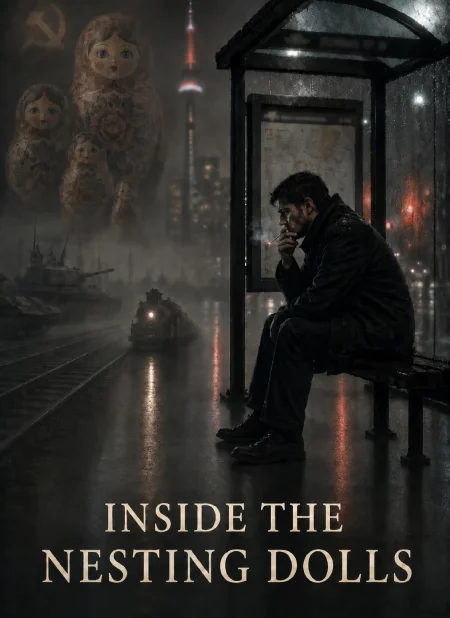

 10 min read
 Part 1
The door screeched. Stefan stepped out of the Chinese restaurant after twelve hours of painting scores of chairs. Pink neon letters and a neon boat glowed above him. The door banged shut behind him. He walked to the bus stop. The bus schedule pinned to the wooden lamppost announced the bus’s arrival at 8:38 p.m. Rain washed the salt off the streets, and a warm wind blew through the dark clouds. Streetlights shifted from green to orange, and then to red. The empty wet road reflected the lights. Silhouettes of trees clattered in the darkness. Tree branches screeched and cracked in the wind. In the distance, the city lights reflected off the clouds’ protruding bellies.
The smell of paint thinner stuck to his hands, clothes, and hair. He could taste it coming from his lungs. He sucked on a cigarette.
At last, he was going home. He evoked the image of his hovel on the first floor above the trash containers: ceiling paint cracked, peeled, and dropped to the floor, and the disturbed cockroaches sprinted across the parquet. Pink plastic flowers sat in a bottle on the table.
Stefan opened his jacket and inhaled the fresh air. He pushed away the black bag’s strap that pressed into his chest. He threw away the cigarette and lit another.
A beautiful black woman walked into the bank and then out. A streetlight cast a cinnamon glow above her. She slipped green bills into a blue, cheetah-print purse. She rummaged through the purse. Makeup clattered. He watched curls dangle in her face, and her red coat with its fur trim finished at the tight, red skirt. He smelled the sweet perfume that the wind brought toward him. He longed to touch her, but he didn’t know how to approach her. His eyes watered in a tearless leap from hope to resignation. Disheartened, he sucked the nipple of the cigarette when she approached him.
“Do you have a light?” she asked.
“Yes,” he stammered, rummaging through his bag – keys, a pen, sheets of paper, books, and a lighter. “Here.”
Her big lips tightened around the long, white cigarette. Her face appeared anew in the flicker of the combusting gas. He recognized the matte smears of her makeup.
“Where you off to?” he asked.
“Home.” She exhaled smoke toward the black sky. She returned the lighter and walked off toward the lamppost.
“Me too,” he yelped, too late, replying only to her back. He still thought about English words too much, still built sentences in his mind word by word. Not slow, but never fast enough. He schemed whole conversations before he opened his mouth. Words poured out. Conversations took unforeseen turns. If his facial features hadn’t revealed him, the sound of his hard consonants and rolling r’s did. His mouth spat the accented words from the crevices of his throat. The strangers’ questions came out and burned.
“No, I’m not Polish, I’m Slovak – former Czechoslovakia,” he explained with patience.
“Oh, Czech?” the questions scalded.
“Eastern Europe, right,” the questions seared, putting him in place, branding his soul.
“Yeah. Yeah, Eastern Europe,” he dispatched a blistered resignation. He was the serf, the bricklayer, the hauler, the demolition expert, the drunk, the Russian, the Eastern European, the Eastern Bloc, the Middle West, the Indigenous peoples of the Iron Curtain, the slave in the Nazi books, white enough to count, not white enough to matter.
Stefan noticed odd habits in people, like speaking English yet calculating math in their native tongue. He decided to rid himself of this peculiarity and pushed the surplus first-language numbers out of his mind, and squeezing in the “one, two, three, four, five…”
The bus pulled up to the stop, and he followed the woman’s behind onto the bus. He dropped his ticket, looking at her. Her lips smiled as he passed. Her perfume entered his nose once more, and then her vast hips disappeared behind the seat never to be seen again. His eyes watered again.