






 Support our Stories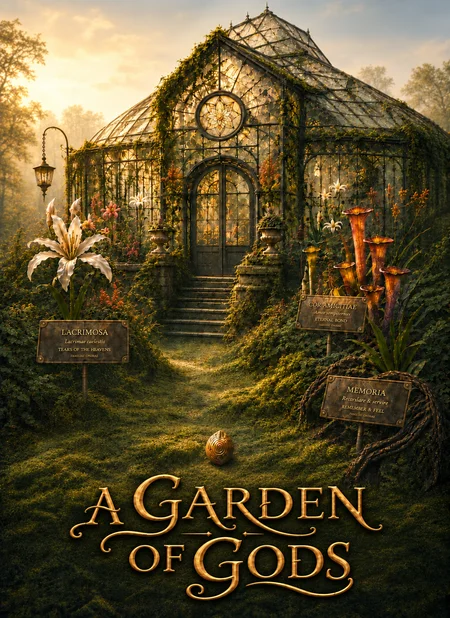

 20 min read
 Part 1
The invitation arrived without a return address. Inside the envelope was a single pressed leaf. Dr. Leah Rowan had been cataloging and studying plants for over thirty years, and she had never seen anything like it. Instead of reaching outward, the veins of the leaf spiraled inward in looping ridges that met in the center like the fingerprint of some forest creature older than names. Under the leaf was a single index card with eleven words handwritten in thick, bold letters: “Things only go extinct when we let them stop moving us.” There was no signature and no name. Only a set of coordinates.
The road slowly dissolved into gravel, then dirt, then two muddy tire tracks swallowed by moss and tall grasses. Her rental car surrendered beneath a canopy of ancient pines about a mile away from the coordinates. She pushed her way through an ancient palisade of maples and oaks that suddenly opened to a wide clearing in a valley of waist-high goldenrods with a gigantic glass-paned structure planted about a hundred yards away. When Leah laid her eyes on the greenhouse, she was sure this was some kind of prank. It stretched across the valley floor like the skeleton of a crystal whale that washed ashore a billion years ago. The weathered greenhouse was so out of place that it made Leah chuckle out loud. Her mind raced with explanations of why someone would build something like this here, but she couldn’t come up with a rational reason.
The primeval forest grew impossibly quiet while she waded through the goldenrod. It wasn’t a silence that felt empty. Emptiness suggests a lack of something. It was the kind of silence an old church has after the entire congregation has gone home. The kind of silence when you had to be dropped off at school too early or picked up too late, and no one else was there anymore. The silence felt as if it held the knowledge that something else was about to happen, as if it were charged with a purposeful expectation.
As she got closer, she observed the acres of cracked glass shimmering beneath vines that looked older than memories. The iron ribs that held the glass panels arched toward a grey overcast sky. Some panes appeared newer than others, as they had slightly different shades of accumulated grime and caught the light in different colours. Brass pipes snaked everywhere in random, nonsensical patterns. They hissed puffs of warm mist up into the air and through broken windows. The whole thing looked less like a botanical garden and more like an abstract painting of a shattered mirror reassembled with molten brass.
Leah rounded a corner and finally found a set of doors that led inside. Near the entrance, an old man was watering some flowers. He wore patched overalls and mud-caked boots. His long white beard disappeared beneath the straps of a faded canvas apron fitted with dozens of pockets filled with pruning shears, miles of twine, several variations of trowels, and other gardening odds and ends. He put the rusty watering can down and looked at Leah with both his hands on his hips.
“Took you long enough,” his words rumbled out in a throaty bellow that reminded Leah of what being caught out in the open of a summer thunderstorm felt like when she was a kid.
“You invited me?” Leah looked around confused and felt inexplicably exposed.
“I invited a botanist,” the old man shrugged, “and now you are here.” He extended a weathered hand that looked like a piece of driftwood, where time and water had washed away the soft earlywood, leaving deep grooves behind. “I am Pliny.”
Leah took his hand long enough for one powerful shake. “You are the groundskeeper here?”